
Three out of five ceiling fan returns are due to one reason: the wrong size.
Not a bad motor. Not a faulty remote. Just a fan that’s too big for the room. Or hung too low for the ceiling.
Knowing how to measure a ceiling fan takes maybe ten minutes with a tape measure.
Yet most buyers skip straight to checking colors and finishes instead.
This blog covers key measurements: blade span, room size, ceiling height, and clearance.
So the fan you order actually fits. Spins quietly. And moves real air through your space.
Understanding Ceiling Fan Size
Ceiling fans fall into industry-standard size brackets: small (29-36 inches), medium (42-48 inches), large (52-56 inches), and extra-large (60+ inches).
These brackets aren’t arbitrary. Manufacturers tune motor torque and blade angle differently for each range.
A 44-inch fan isn’t just smaller than a 52-inch one; it’s built with different internal specs.
So shop by bracket first. Fine-tune the exact size afterward.
This avoids fixating on one number that may not even matter much within its bracket.
Ceiling Fan Measurement Chart by Room Size
Use this chart to match your room’s square footage to the right fan bracket in seconds.
| Room Size (sq ft) | Recommended Fan Size | Typical Room |
|---|---|---|
| Up to 50 | 29-36 inches | Closet, small bathroom, laundry nook |
| 51-100 | 36-42 inches | Home office, breakfast nook |
| 101-175 | 44-48 inches | Standard bedroom, den |
| 176-250 | 52-56 inches | Living room, master bedroom |
| 251-350 | 56-60 inches | Large family room, combined kitchen-dining |
| 351-450 | 60-72 inches | Great room, open-concept space |
| 450+ | Two fans recommended | Oversized or irregularly shaped layouts |
How to Measure Your Room Correctly Before Choosing a Fan
Follow these steps to ensure an accurate, return-proof measurement.
- Sketch a rough floor plan of the room on paper first.
- Mark all doorways, windows, and built-in furniture on the sketch.
- Note any alcoves or nooks separately if the room isn’t a perfect rectangle.
- Add up the irregular sections individually, then combine them to get the total square footage.
- Mark where the existing light fixture or electrical box sits on the sketch.
- Check if that spot is the room’s true center or off to one side.
- Identify tall furniture (wardrobes, bookshelves) that sits near the fan’s path.
Step-by-Step: How to Measure a Ceiling Fan the Right Way
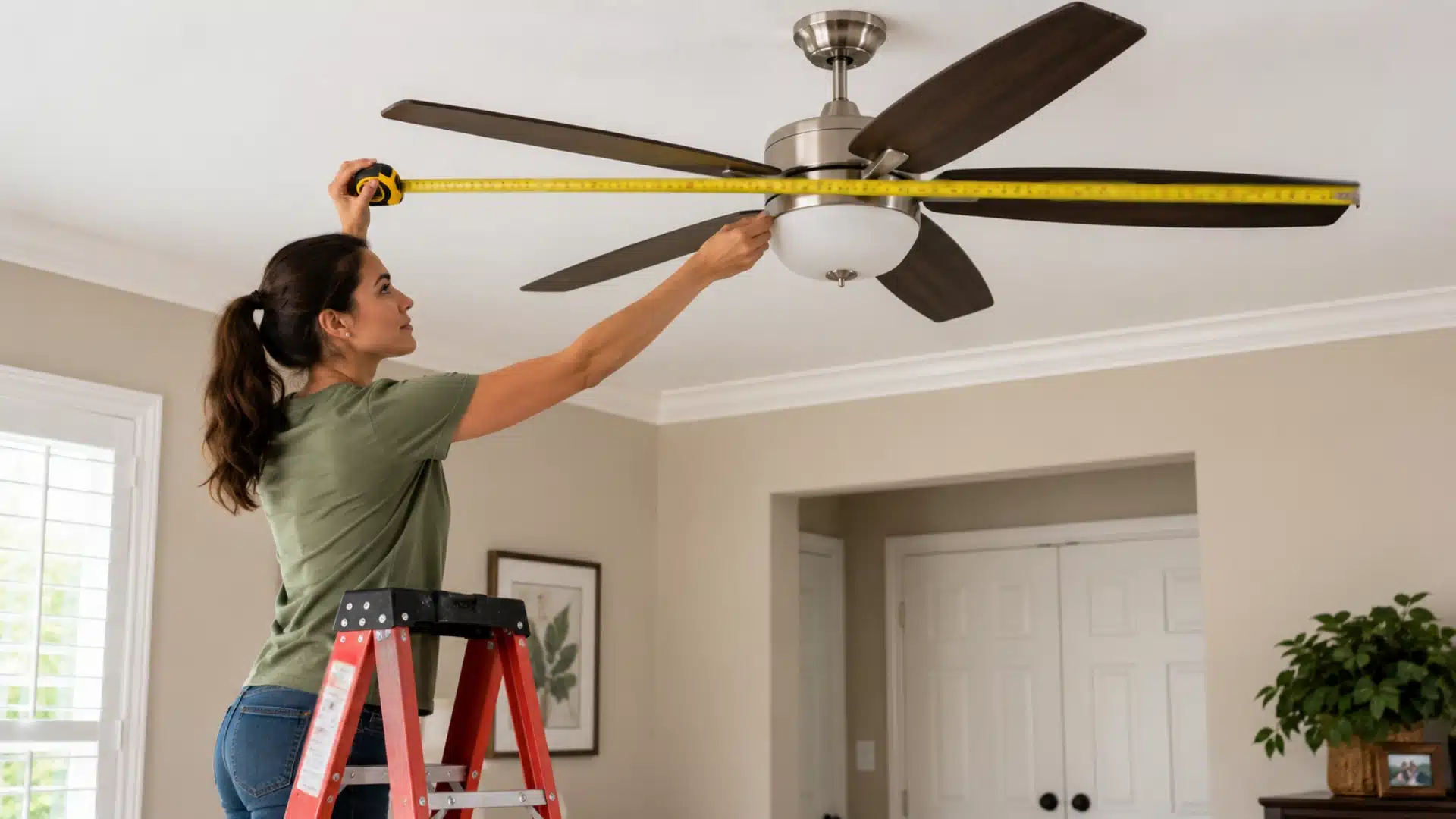
Grab a tape measure and follow these steps to get the true blade span, not a guessed one.
Step 1: Count the Blades First
Even-numbered fans (4- or 6-bladed) let you measure directly.
Odd-numbered fans (3- or 5-bladed) require a different approach below. Knowing the count first prevents the use of the wrong method and an inaccurate span reading.
Skipping this step is the most common cause of a wrong measurement.
Step 2: Measure Tip-to-Tip for Even Blade Counts
Extend the tape measure from the outer tip of one blade straight across to the tip of the blade directly opposite it.
This diagonal line instantly gives the true blade span, with no calculation needed. Keep the tape flat and straight for an accurate reading.
Step 3: Measure Center-to-Tip for Odd Blade Counts
Measure from the motor housing’s center point to one blade tip. Double that number. This works around the lack of a directly opposite blade, giving an accurate span without needing extra tools or guesswork.
Round up slightly if the blade tip is curved or angled.
Step 4: Measure the Motor Housing Width Separately
Measure the motor body’s diameter on its own, excluding blades.
This number matters for tight ceiling spaces or low-profile installs, where housing width affects clearance more than overall blade span does. Manufacturers rarely list this figure clearly, so a manual check helps.
Step 5: Record the Mounting Bracket Diameter
Measure the bracket plate that attaches to the ceiling box. This confirms compatibility with your existing electrical box before purchase, avoiding a mismatch that surfaces only during installation.
Note the screw-hole spacing too, since brackets vary by brand
Ceiling Height vs Fan Size: Getting the Perfect Fit
Ceiling height changes, which fan size actually works, not just which one looks good.
Low ceilings (under 8 feet) need flush-mount fans since standard mounts eat into headroom.
Standard ceilings (8-9 feet) suit a basic mount with minimal drop. Higher ceilings (10 feet and above) need extended mounting to bring the fan down to an effective height.
A fan mounted too high pushes air upward, reducing its cooling power.
Match height first, then size a fan that still underperforms if it hangs too far from the airflow zone.
Style and Placement Considerations Tied to Measurement

Measurements shape which fan style suits a space, not just which size fits. A sleek modern fan looks lost on a textured beam ceiling, while an ornate fan crushes a minimalist room.
Placement matters just as much as style choice.
- Center the fan over the room’s main seating or sleeping zone, not the geometric room center.
- In L-shaped rooms, position the fan over the larger functional section.
- Keep at least 18-24 inches between the fan and any wall-mounted artwork or shelving.
- Choose flush mounts for rooms with crown molding to avoid a visual clash.
- Match finish (brushed nickel, matte black, wood tone) to existing hardware in the room.
- Avoid oversized fans in rooms with low, ornate light fixtures already competing for attention.
Airflow and Energy Basics Every Buyer Should Understand
CFM (Cubic Feet per Minute) measures how much air a fan actually moves.
It matters more than blade span alone. Two fans with the same size can have very different CFM ratings.
Check CFM against room square footage, not just the size chart.
Energy Star certification confirms a minimum efficiency threshold, not top-tier performance. DC motors use less electricity than AC motors and run quieter. They cost more upfront but save on monthly power bills.
Prioritize CFM and motor type alongside size for genuine comfort and lower running costs
How Room Type Changes Ceiling Fan Measure Choice
Room function affects fan choice beyond square footage. Here’s what to adjust by room type.
| Room Type | Key Measurement Focus | Special Consideration |
|---|---|---|
| Bedroom | Blade clearance over bed | Choose a quieter motor for nighttime use |
| Kitchen | Clearance from cabinets and hanging lights | Damp-rated blades resist grease and moisture |
| Bathroom | Clearance from the shower steam zone | A damp- or wet-rated fan is required |
| Covered Patio | Outdoor humidity exposure | Wet-rated fan with weatherproof blades |
| Garage | Ceiling obstructions (shelving, garage door track) | Industrial-grade motor for dust tolerance |
| Home Office | Distance from desk and monitor glare | Lower CFM to avoid paper and cable disturbance |
| Nursery | Height from the crib top surface | Light-dimming and silent-mode features matter |
Common Mistakes When Measuring a Ceiling Fan
Many buyers measure only one blade’s length and multiply, ignoring slight angle variations between blades.
Others skip checking if their ceiling box can bear the fan’s weight before purchase.
Some forget to account for trim or crown molding that reduces usable clearance. A frequent error is measuring with blades in motion-bent positions instead of fully extended.
Buyers also overlook checking voltage compatibility when replacing imported fans.
Lastly, many skip remeasuring after furniture rearrangement, assuming old clearance numbers still apply.
Quick Checklist Before You Buy a Ceiling Fan
Run through this final checklist before adding the fan to your cart.
- Confirm the room’s wiring supports the fan’s wattage rating.
- Check the warranty length and what it actually covers (motor vs. blades).
- Verify the box includes a wall control or remote, not sold separately.
- Check return policy specifics for installed vs. uninstalled fans.
- Confirm blade material suits humidity levels if near a kitchen or bath.
- Look up the noise rating (dB) if used in a sleeping space.
Wrapping It Up!
Getting this right isn’t complicated. It just takes a tape measure and a few minutes of attention.
Blade span, room size, ceiling height, clearance that’s the full list.
Now you know how to measure a ceiling fan the correct way, not the guessed way. Skip a step, and the fan underperforms or looks wrong the moment it’s installed. Get all four right, and it just works.
Grab your tape measure. Note your numbers.
Then shop with confidence instead of crossing your fingers at checkout.
Frequently Asked Questions (FAQ’s)
1. What Size Ceiling Fan Do I Need for a 12×12 Room?
A 144-square-foot room needs a 44-48 inch fan for proper airflow.
2. How do I Measure a Ceiling Fan with 3 Blades?
Measure center-to-tip, then double that number for true blade span.
3. Is It Better to Size Up Or Down Between Two Fan Sizes?
Size up slightly for better airflow; oversizing rarely causes real problems.
4. Can a Ceiling Fan Be Too Big for a Room?
Yes, oversized fans overwhelm small rooms and create excessive, uncomfortable airflow.