
I noticed one myself last summer, tucked in the corner near my back door.
A little cluster of hardened mud, stuck right under the porch ceiling. At first I had no idea what it was.
Turns out it belongs to a mud dauber, a small wasp that builds quietly and mostly keeps to itself. Have you, too, spotted one yet, somewhere on your own porch or shed?
Come, let’s take a closer look at what these nests are, how the wasp behind them behaves, and what to actually do about it.
Getting to Know the Mud Dauber Wasp
Mud daubers are solitary wasps, meaning there is no colony, no queen, no teamwork involved.
Each female builds and manages her own nest from start to finish.
Mud Daubers belong to the wasp families Sphecidae and Crabronidae, and you will usually spot one of three common types:
- the organ-pipe mud dauber, known for its tube-like nests,
- the black-and-yellow mud dauber, and
- the blue mud dauber, which has a striking metallic sheen.
These wasps show up almost everywhere across the US, from backyard sheds in the Midwest to porches along the coasts, adapting easily to homes and open spaces alike.
What Does a Mud Dauber Look Like?
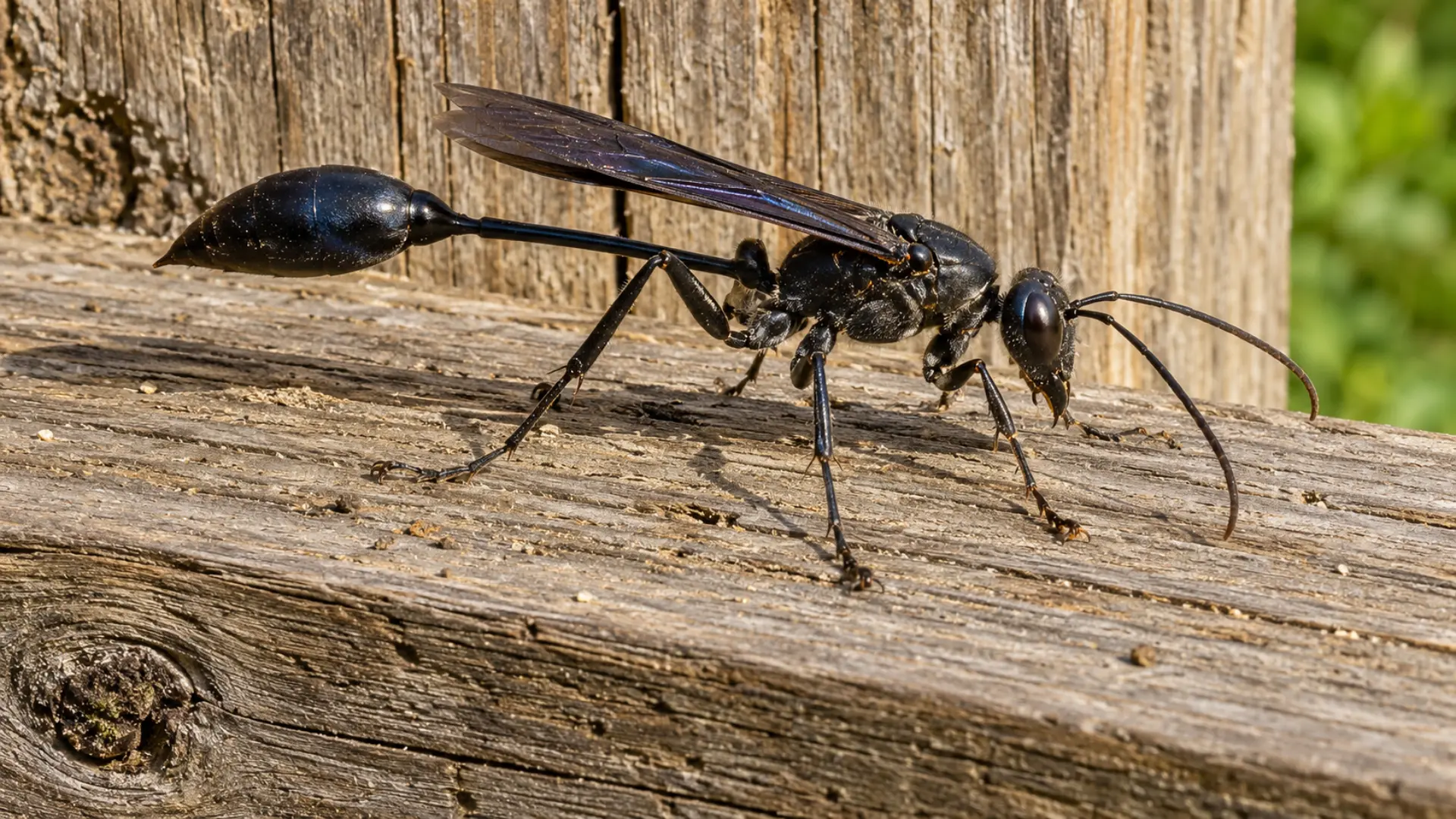
A mud dauber usually measures somewhere between ¾ and 1 inch long, slender and narrow-bodied, nothing like the fuzzy build of a bee.
Coloring varies by species; some are solid black, others carry black-and-yellow markings, while a few flash a metallic blue-black sheen in the right light.
The real giveaway, though, is the thin, thread-like waist connecting its thorax to its abdomen, a feature that sets it apart instantly from paper wasps and yellow jackets.
Feature | Mud Dauber | Paper Wasp | Yellow Jacket |
|---|---|---|---|
Waist | Long, thread-thin | Slightly narrow | Thick, no visible waist |
Color | Black or blue-black, some yellow | Brown with yellow marks | Bright yellow and black |
Aggression | Low | Moderate | High |
What Does a Mud Dauber Nest Look Like?
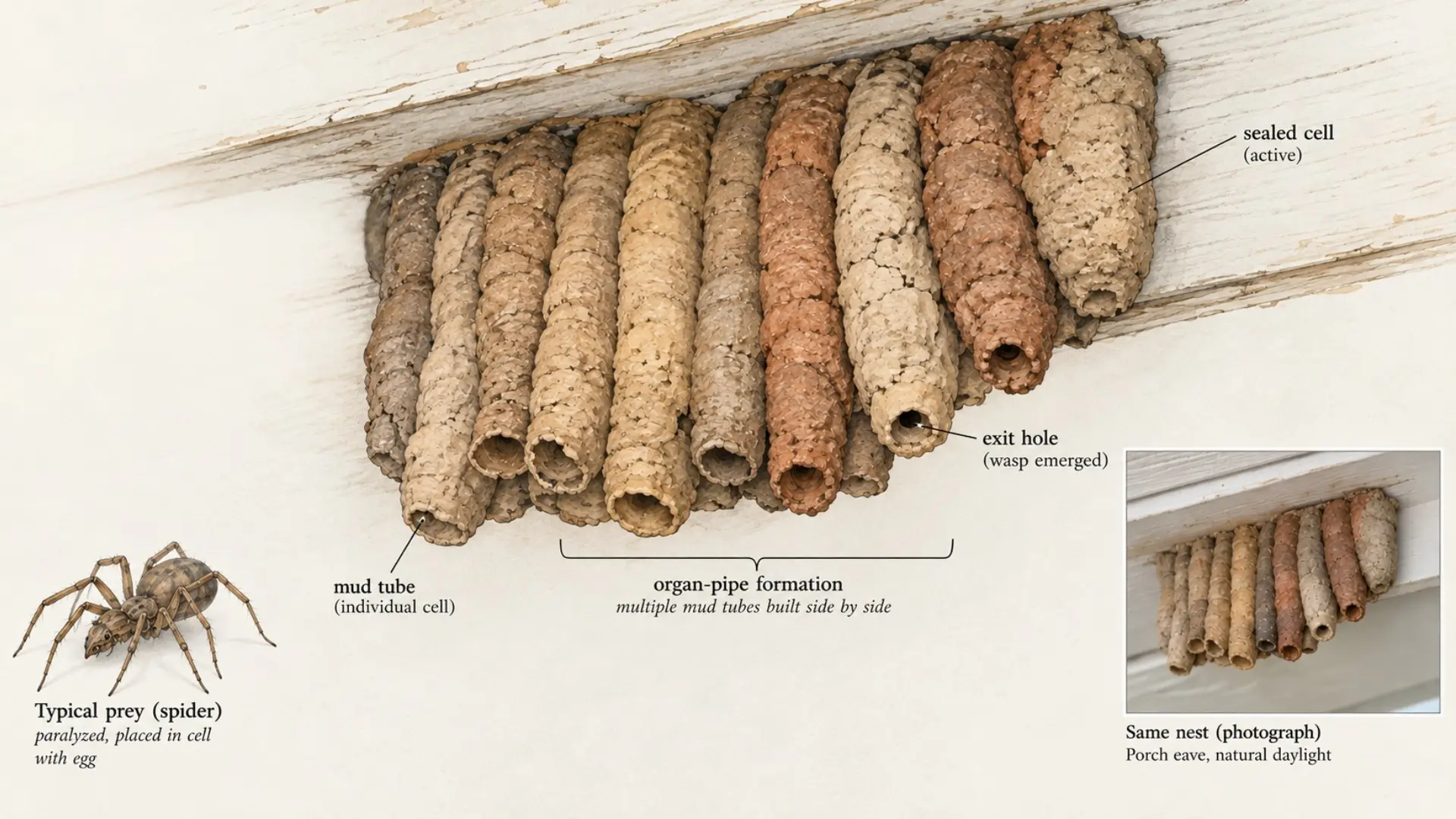
Once I knew what to look for, I started spotting these nests everywhere, tucked into corners I’d walked past a hundred times without noticing.
This is what actually gives one away.
Shape and Texture
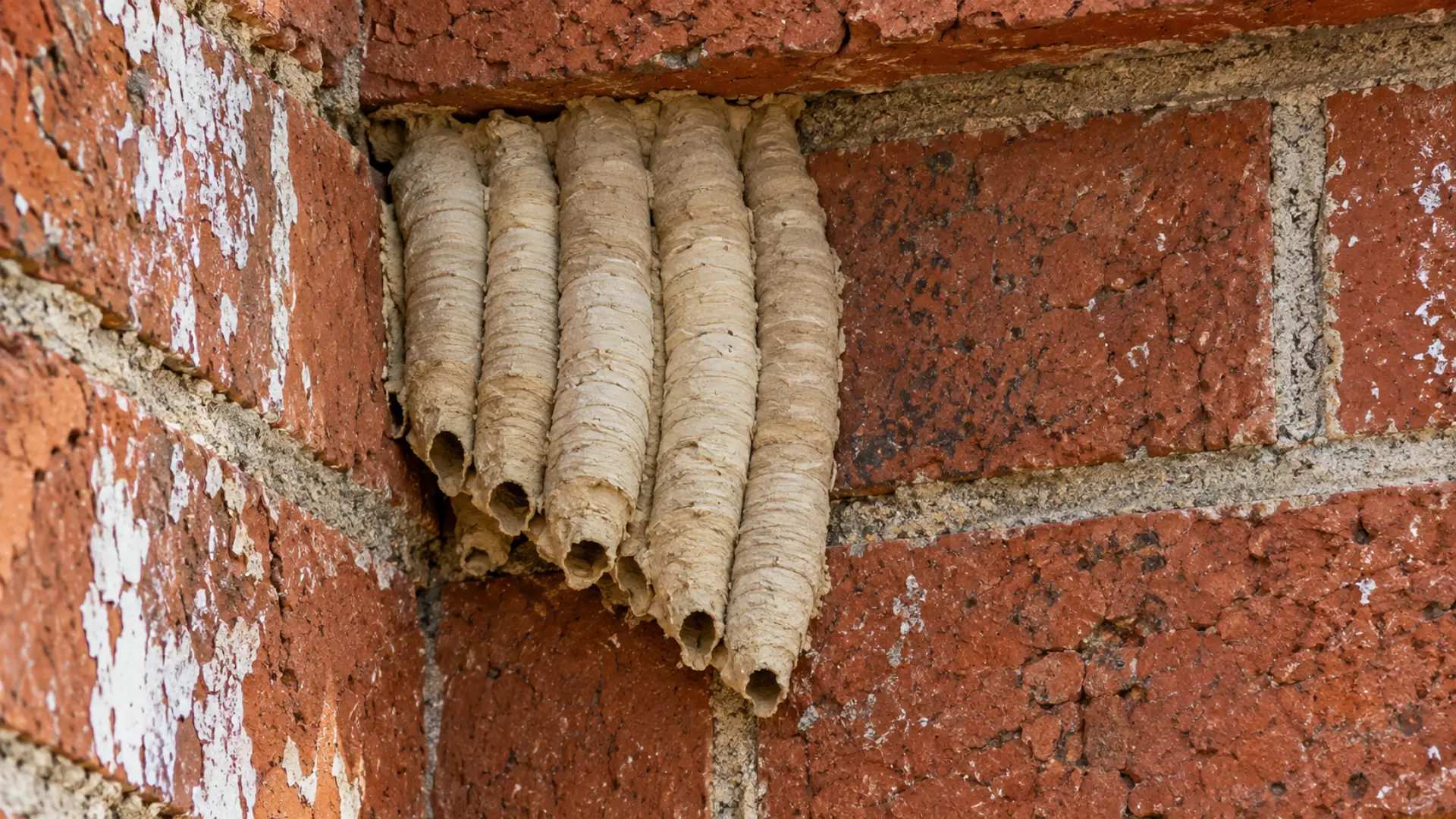
Mud dauber nests are built from tiny mud tubes, packed side by side until they form one solid structure.
Depending on the species, you will either see a neat organ-pipe shape, several parallel tubes stacked like tiny drainpipes, or a rougher, clustered globular mass that looks almost like dried clay dripped down a wall.
Either way, the texture stays rough and earthy, nothing smooth or symmetrical about it.
Where You’ll Usually Find One
These nests show up in sheltered, dry spots where rain won’t wash the mud away.
Porch ceilings and eaves are common, along with sheds, garages, and barns. I have found them tucked in corners just above a door frame, somewhere shaded but still close to the outdoors, which seems to be exactly what these wasps look for.
Size and Color
A typical nest stays fairly compact, rarely sprawling more than a few inches across.
Color depends on the local soil the wasp used to build it, so you will see anything from pale tan to reddish-brown or dull gray, matching whatever mud was nearby.
Active or Abandoned?
This part’s simple once you know it. If the nest looks smooth and sealed, it is likely still active, with larvae developing inside.
But if you spot small, round exit holes dotting the surface, that means the wasps have already emerged, and the nest is empty.
Mud Dauber Nest-Building and Life Cycle
Watching one of these wasps work, even just in photos, made me appreciate how much effort goes into something most people walk right past.
Here’s the process from start to finish.
- She works entirely alone, no colony, no queen, no help from other wasps.
- She hunts down and paralyzes spiders, packing them into the nest as food.
- Each egg gets laid inside a mud cell, sealed off right after.
- The larva feeds, molts, and pupates inside its own sealed chamber.
- Eventually it emerges as an adult wasp, leaving a small round exit hole behind.
- Old nests often get reused or expanded, sometimes across more than one season.
It’s a strangely solitary, almost solitary-parent kind of process, one female doing every job herself, start to finish, without a single helper along the way.
Are Mud Daubers Dangerous?
Honestly, not really, and that surprised me too when I first read into it.
Mud daubers are generally non-aggressive, and since they don’t live in colonies, there’s no nest to defend and no group ready to swarm.
Stings are rare, usually only happening if one gets directly handled or physically threatened.
In fact, they are doing you a favor, acting as natural spider control around your property. That said, a little caution still makes sense.
Anyone with a known wasp or bee sting allergy should avoid direct contact, and it is worth giving the nest space rather than poking at it out of curiosity.
Should You Remove a Mud Dauber Nest?
Not every nest needs to go. If it is tucked somewhere out of the way and inactive, it is usually fine to just leave it there, doing its quiet, harmless thing.
But a few situations do call for removal, especially when the nest sits somewhere you or your family pass by often.
Here’s how to know which side yours falls on.
Signs it’s time to remove the nest
- Located near a door, window, or walkway.
- Sitting in a high-traffic area where contact is likely.
- Becoming a visible eyesore on your porch or exterior.
- Keeps growing or getting reused season after season.
Doing it yourself, or calling in help
- Best removed in early morning or evening, when wasp activity is lowest.
- Use a long-handled tool and keep a safe distance while scraping it off.
- Wear gloves and eye protection as a basic precaution.
- If it’s large, high up, or you’re just not sure, it’s safer to call a pest control professional.
Once it is gone, a little prevention keeps new ones from showing up.
Keeping future nests away
- Seal gaps and cracks around eaves, vents, and siding.
- Reduce standing water or damp mud sources near the house.
- Adjust exterior lighting, since bright lights can draw nesting activity nearby.
Mud Daubers vs. Other Wasps
Not all wasps are built (or behave) the same way, and knowing the difference can save you from panicking over a perfectly harmless nest.
This side-by-side look shows where mud daubers land compared to the other wasps you’re likely to spot around your home.
Wasp Type | Nest Type | Aggression Level | Danger Level |
|---|---|---|---|
Mud Dauber | Mud tubes, organ-pipe or clustered | Low | Low |
Paper Wasp | Open, umbrella-shaped paper comb | Moderate | Moderate |
Yellow Jacket | Enclosed paper nest, often underground | High | High |
Hornet | Large enclosed paper nest, aerial | High | High |
As the table shows, mud daubers sit firmly on the calmer end of the spectrum, which is exactly why most experts agree they are one of the least concerning wasps to find near your house.
The Closing Note
Finding a mud dauber wasp nest tucked into a quiet corner of your home doesn’t have to feel alarming.
Once you know what to look for, that changes. You start seeing how these wasps actually behave.
And that little mud structure stops looking like a threat. It starts looking like a small, quiet piece of nature, just going about its business nearby.
Now you are equipped to make the call either way, leave it be or take it down.
Have you spotted a mud dauber nest around your own place? Drop a comment below and tell me where you found yours, I’d love to know.
Frequently Asked Questions (FAQs)
Do Mud Daubers Sting?
They can, but it is rare and usually only happens if one is handled directly. Left alone, they rarely bother anyone at all.
Are Mud Dauber Nests Dangerous to Have Around the House?
Not really, they’re low-risk and even help by keeping spider populations down. The main concern is just location, not the wasp itself.
How Do I Get Rid of a Mud Dauber Nest?
Scrape it off with a long-handled tool during early morning or evening hours, when activity is lowest. For larger or hard-to-reach nests, calling a professional is the safer route.
Do Mud Daubers Come Back to the Same Nest?
Yes, they often reuse or expand old nests across multiple seasons. An empty-looking nest might still get occupied again later.
What’s the Difference Between a Mud Dauber and a Wasp?
A mud dauber actually is a type of wasp, just a solitary one that builds alone instead of living in a colony. Wasps like yellow jackets or hornets, by contrast, live socially and tend to be far more aggressive.