
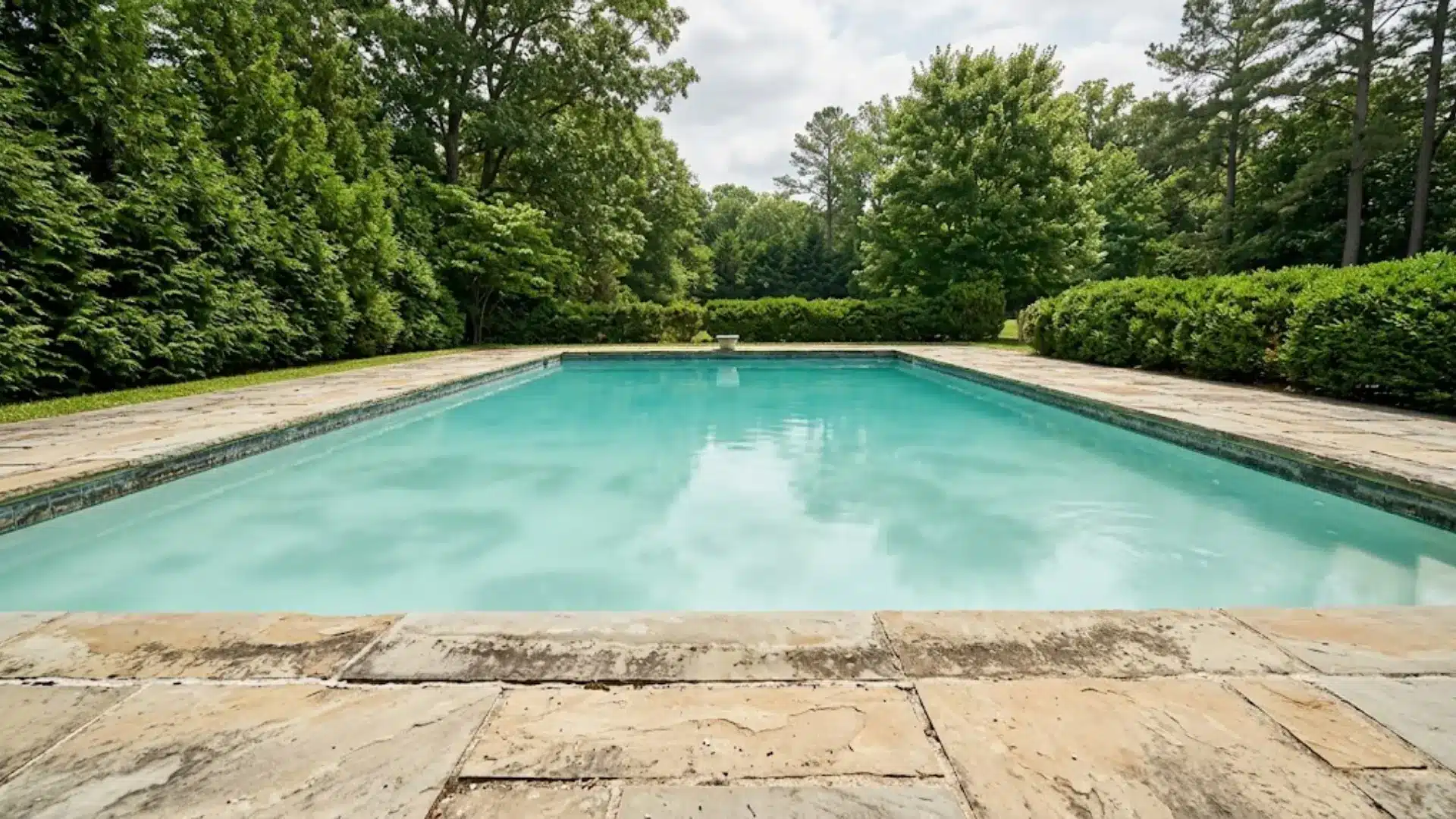
Stepping out to your pool and finding it hazy instead of crystal clear feels like such a letdown, especially when you were ready for a relaxing swim.
Cloudy pool water is one of those problems almost every pool owner runs into at some point, and honestly, it rarely means disaster.
Most of the time, it is just your water trying to tell you something about its chemistry or filtration. You do not need to drain a single drop to fix it.
Below, you will find what causes the haze, a simple cloudy pool water fix you can try at home, easy ways to keep it from coming back, and how to know when it is time to call in a professional.
What Does Cloudy Pool Water Mean?
Cloudy water usually appears as a white or gray haze, somewhere between slight dullness and complete opacity, which is quite different from green water, which indicates algal growth instead.
As for swimming in it, that depends on how bad the haze is.
Beyond looking unappealing, cloudiness poses real safety concerns, as reduced visibility can hide hazards such as steps or toys at the bottom.
If sanitizer levels are low and the cloudiness is high, bacterial risks climb too. A light haze is usually fine for a quick dip, but heavy cloudiness is best avoided until it clears.
What Causes Cloudy Pool Water?
Cloudiness rarely comes from just one issue. Most of the time, it is a mix of unbalanced chemistry, weak filtration, and outside debris working together against your water.
1. Improper Water Chemistry
When pH, chlorine, alkalinity, calcium, or cyanuric acid drift outside their ideal ranges, water loses its ability to stay clear.
High pH triggers calcium precipitation and weakens chlorine effectiveness, while low free chlorine leaves contaminants unchecked. High alkalinity, calcium hardness, and cyanuric acid each add their own strain on clarity.
| Water Parameter | Ideal Range | Cloudy Water Risk |
|---|---|---|
| pH | 7.2–7.6 | High |
| Free Chlorine | 1–3 ppm | High |
| Total Alkalinity | 80–120 ppm | Medium |
| Calcium Hardness | 200–400 ppm | High |
| Cyanuric Acid | 30–50 ppm | Medium |
2. Poor Filtration
A dirty filter or clogged cartridge cannot trap the fine particles causing haze, and the same goes for sand filters experiencing channeling or DE grids that have aged past their prime.
An undersized filtration system struggles to keep pace with your pool’s volume, and even a properly sized one will not help if it is not running enough hours each day.
3. Poor Water Circulation
Cloudiness often collects in dead spots where water barely moves. Pump problems, blocked skimmers, or closed return jets all interrupt the flow needed to keep particles suspended and pulled toward the filter.
Without adequate daily pump runtime, even balanced, well-filtered water can start looking dull and lifeless again.
4. Algae Beginning to Grow
Before algae turns water green, it often makes it cloudy first. Watch for slippery walls, a sudden rise in chlorine demand, or small green patches forming in shaded corners.
Catching algae at this early stage makes treatment far easier than waiting until the whole pool turns visibly green.
5. Environmental Debris
Dust, dirt, pollen, leaves, and ash can quickly cloud water, especially after heavy rain or runoff, or during nearby construction work.
These particles overwhelm your filter and sanitizer simultaneously, since they introduce both physical debris and organic material, your chlorine then has to work overtime to break them down.
6. Heavy Pool Usage
Sunscreen, body oils, cosmetics, and sweat are organic contaminants that accumulate quickly during busy pool days.
These substances significantly increase sanitizer demand, and when chlorine cannot keep up with the load, the water often turns hazy within hours of a particularly crowded swim session.
7. Recent Chemical Treatments
Cloudiness sometimes follows right after adding calcium increaser, shock treatment, flocculants, or clarifiers, especially if they were mixed improperly or added too quickly.
This is usually temporary and clears within a day or so as the chemicals fully dissolve and circulate evenly through the water.
How to Diagnose Why Your Pool Water is Cloudy?
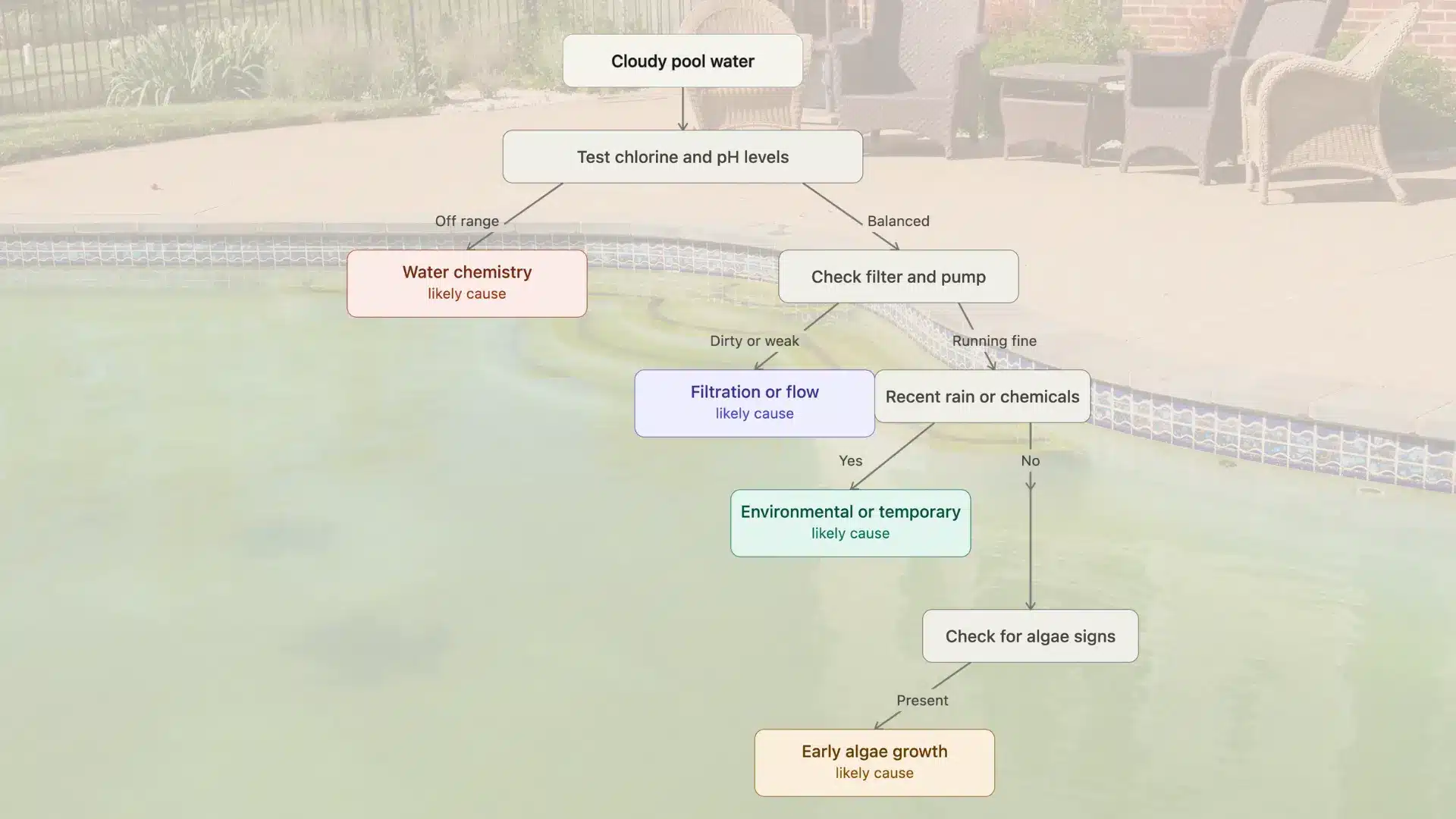
Before fixing anything, it helps to figure out exactly what is behind the haze. Run through this checklist to narrow things down quickly.
- Is chlorine low? Test your free chlorine first, since low levels are the most common cause of cloudiness.
- Is pH too high? Check if pH has climbed above the ideal range, as high pH often pairs with low chlorine effectiveness.
- Is the filter clean? Inspect whether it looks dirty or clogged, since this directly limits how well particles get removed.
- Is the pump running properly? Confirm it is completing its full daily cycle and that water is circulating evenly throughout.
- Has it rained recently? Heavy rain often introduces debris and dilutes the chemical balance.
- Is algae beginning to show? Look for slippery walls or faint green patches, both early indicators that algae may be growing.
- Was anything added recently? Recall if you added shock, a clarifier, or a calcium increaser in the last day or two.
- Are there fine particles floating? This usually points toward filtration rather than chemistry.
Once you have answers to these, the cause usually becomes obvious. Low chlorine paired with high pH points straight to chemistry. A clean chemical profile with poor circulation points to filtration or pump issues.
Recent rain or recent chemical additions usually mean patience is the real fix.
Step-by-Step: How to Fix Cloudy Pool Water?
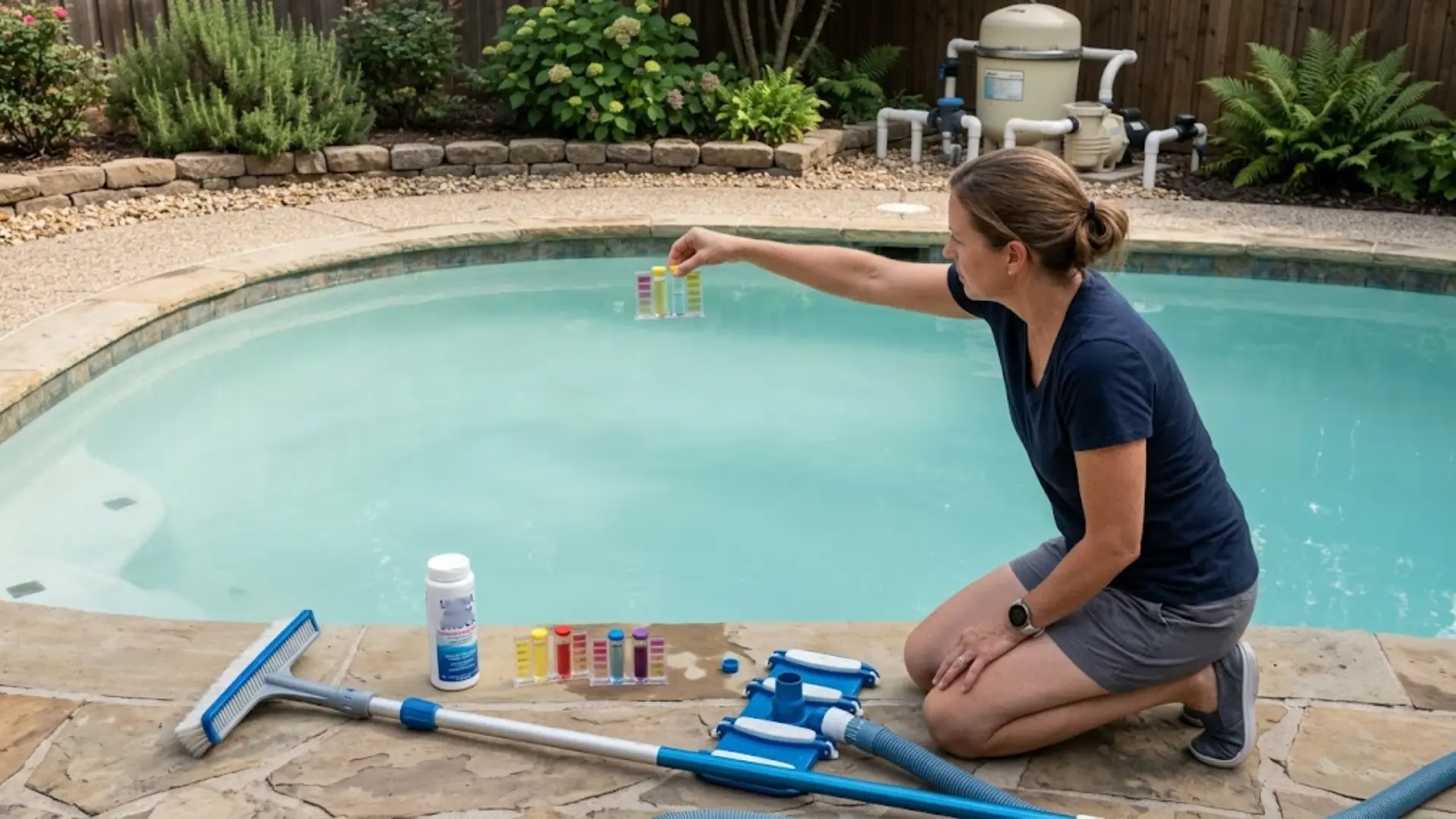
Once you know what is causing the haze, fixing it usually follows a predictable order. Work through these steps, and your water should start clearing within a day or two.
Step 1: Test the Water
Before making any adjustments, test pH, chlorine, alkalinity, calcium hardness, and cyanuric acid so you know exactly where your water stands.
A quality liquid test kit provides far more accurate readings than strips, which often shift color inconsistently, making precise dosing difficult.
Skipping this step usually leads to overcorrecting one chemical while ignoring another that is just as out of balance.
Step 2: Balance Water Chemistry
Adjustments work best in a specific order since each parameter affects the next.
- Alkalinity First: Stabilizes pH so it does not bounce around after adjustment.
- pH Second: Brings water into the range where chlorine works efficiently.
- Calcium Hardness Third: Prevents corrosion or scaling once pH is steady.
- Chlorine Last: Sanitizes effectively once the surrounding water chemistry is balanced.
Following this sequence keeps every adjustment from undoing the one before it.
Step 3: Shock the Pool If Needed
Shocking helps when chlorine demand is high, algae are starting to grow, or cloudiness persists despite balanced chemistry.
Calcium hypochlorite, dichlor, and liquid chlorine are the most common shock types, each suited to slightly different situations.
Evening is the best time to shock, since sunlight quickly burns off chlorine during the day. Afterward, wait until chlorine drops back into a safe swimming range before getting in.
Step 4: Clean the Filter
Filter type determines maintenance:
- Cartridge Filters: Rinse every 2 to 4 weeks and deep-clean every few months.
- Sand Filters: Backwash when pressure rises eight to ten psi above normal, and replace sand every five to seven years.
- DE Filters: Backwash and recharge with fresh DE every four to six weeks.
Keeping filters on schedule prevents the buildup that often leads straight back to cloudy water.
Step 5: Run the Pump Longer
Under normal conditions, eight hours a day usually keeps water properly filtered.
During active cleanup, extending that to ten or twelve hours helps clear haze faster by cycling water through the filter more often.
After storms or heavy debris loads, running the pump continuously for a day or two gives the system enough time to catch up on the extra load.
Step 6: Vacuum and Brush the Pool
Brushing the walls and floor loosens trapped particles and biofilm that vacuuming alone cannot reach, especially in corners, steps, and along the waterline where debris tends to settle.
Once loosened, vacuuming pulls those particles out of the water rather than letting the filter handle everything, which shortens clearing time and keeps the filter from getting overwhelmed too quickly.
Step 7: Use a Pool Clarifier
Clarifiers work by binding tiny particles together so your filter can actually catch them, rather than letting them slip straight through the system.
They are most effective on mild, lingering haze that has not responded to balanced chemistry alone.
Their main limitation is that they take time to work and are not strong enough to handle heavy cloudiness caused by major chemical imbalances or storm debris.
Step 8: Use a Pool Flocculant When Necessary
Unlike clarifiers, flocculants cause particles to settle to the pool floor rather than relying on the filter to remove them.
This requires a vacuum-to-waste process afterward, in which settled debris is vacuumed directly out of the pool rather than recirculated.
Flocculants work best for severe cloudiness, like after a major storm, when you need fast results and do not mind losing some water in the process.
Pool Clarifier vs. Pool Flocculant: Which One Should You Use?
Both products clear haze, but they work in completely different ways and suit different situations.
This table breaks down how they compare.
| Feature | Clarifier | Flocculant |
|---|---|---|
| Speed | Moderate | Fast |
| Requires Vacuuming | No | Yes |
| Best For | Mild cloudiness | Severe cloudiness |
| Works with Filter | Yes | Settles debris |
| Ease of Use | Easy | Moderate |
How Long Does It Take to Clear Cloudy Pool Water?
Recovery time depends on the severity of the cloudiness, your filtration strength, chemical balance, current weather, and whether algae is involved.
Generally, clearing falls into three timelines.
- Minor Cloudiness: Clears within twelve to twenty-four hours with basic correction
- Moderate Cloudiness: Takes one to three days as filtration catches up
- Severe Cloudiness: Can take three to seven days, especially after storms or algae
Patience matters here since rushing the process with extra chemicals often makes water hazier before it clears.
Why is My Pool Still Cloudy After Shocking?
Shock does not always clear water instantly, and a few lingering issues are usually behind it.
- Dead Algae: Filter it out by running the pump continuously until the water clears.
- Dirty Filter: Clean or backwash it to prevent trapped particles from recirculating.
- High Calcium: Test hardness and consider a partial drain if levels are excessive.
- Poor Circulation: Check for blocked skimmers or closed jets restricting water flow.
- Incorrect pH: Rebalance pH so chlorine can actually do its job.
- Overstabilized Chlorine: Lower cyanuric acid if it is blocking sanitizer effectiveness.
- Insufficient Filtration Time: Extend pump runtime to give the filter more cycles.
Once these are addressed, water typically starts clearing within a day, since shocking simply needs the right conditions to finish the job.
Why is My Pool Cloudy After Rain?
Rain brings more than water into your pool. It dilutes chlorine levels, washes in dirt and organic debris, and often shifts pH depending on the acidity of local rainfall.
Leaves, pollen, and runoff add extra particles your filter then has to work through.
Recovery starts with testing and rebalancing chemistry first, since diluted chlorine and shifted pH need correcting before anything else helps.
Run the pump for an extended stretch, clean the filter if debris was heavy, and vacuum or brush away any settled sediment.
Most storm-related cloudiness clears within a few days once chemistry and filtration catch up.
Why is My Pool Cloudy But Chemical Levels Are Normal?
Balanced chemistry does not always guarantee clear water, since a few other culprits can still cause haze.
- Microscopic Debris: Particles too fine for your filter to trap on its own.
- Dirty Filter: Even balanced water clouds up if filtration cannot keep pace.
- Calcium Precipitation: Can occur even within normal ranges if water temperature shifts suddenly.
- Air Bubbles: Sometimes mistaken for cloudiness, usually clearing on their own within hours.
- Filter Bypass: A valve issue that lets unfiltered water back into the pool.
- Fine Pollen: Settles slowly and often slips straight through a filter that needs cleaning.
To diagnose this, check the filter pressure first, then inspect the valves for bypass issues, and consider a clarifier if microscopic debris appears to be the main holdup.
How to Prevent Cloudy Pool Water?
A few consistent habits keep cloudiness from becoming a recurring problem in the first place.
- Maintain Proper Water Chemistry: Test and adjust regularly so levels never drift far off range.
- Clean the Filter Regularly: Stick to a schedule based on your filter type to keep it working efficiently.
- Run the Pump Daily: Give water enough circulation time to stay properly filtered.
- Brush and Vacuum Weekly: Loosen and remove debris before it builds up.
- Shock After Heavy Use: Replenish chlorine demand following busy swim days or storms.
Staying ahead of these basics means fewer surprises and far less time spent troubleshooting cloudy water later on.
When Should You Drain and Refill a Cloudy Pool?
Draining is usually a last resort, but a few situations genuinely call for it instead of continued chemical treatment.
| Situation | Partial or Full Drain | Why |
|---|---|---|
| Extremely High CYA | Partial | Dilutes stabilizer without fully resetting water |
| Excessive Calcium Hardness | Partial to Full | Depends on how far above ideal range levels sit |
| Severe Contamination | Full | Ensures all contaminants are completely removed |
| Persistent Cloudiness Despite Treatment | Partial | Often enough once a stubborn imbalance is diluted |
| Old Water with High TDS | Full | Dilution alone rarely brings dissolved solids back down |
The Bottom Line
Clear water always comes back to the basics: balanced chemistry, steady filtration, and a little consistency along the way.
The next time your pool looks a bit hazy, you will already know exactly where to start instead of feeling stuck.
Small, regular habits make far more difference than any single fix ever could, and that peace of mind is worth the few extra minutes each week.
If cloudy pool water has been giving you trouble lately, drop a comment below and share what finally worked for your setup. Your experience might be exactly what another reader needs to read today.
Frequently Asked Questions (FAQs)
Can Too Much Chlorine Make Pool Water Cloudy?
Yes, excessive chlorine can sometimes cloud water by disrupting calcium balance or reacting with other chemicals. This is less common than low chlorine but still worth checking if levels run unusually high.
Does Baking Soda Clear Cloudy Pool Water?
Baking soda raises alkalinity rather than directly clearing cloudiness, though stabilizing alkalinity does support overall water balance. It works best as a supporting step, not a standalone fix for haze.
How Often Should I Run My Pool Filter?
Most pools need around eight hours of daily filtration to stay clear under normal conditions. That runtime should extend during cleanup periods or after heavy use, rain, or storms.
How Do I Know if Cloudy Water is Caused by Algae?
Algae-related cloudiness often comes with slippery walls, rising chlorine demand, or faint green patches in shaded corners. If chemistry looks balanced but these signs appear, algae is likely the cause.